
There was a point during our exterior makeover when I genuinely started to wonder if this entire project was going to be one headache after another.
If you’ve followed along with the brick saga, you already know this house has given us plenty of opportunities to question our decision-making skills.
The windows were about to give us another one.
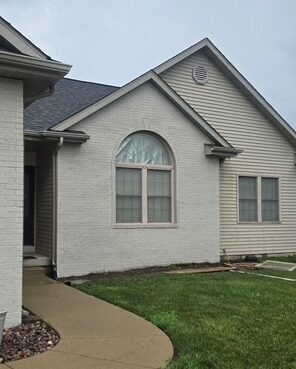
Our original window frames were beige, and as the rest of the exterior started changing, I knew I wanted more contrast. Painting vinyl windows dark seemed like the answer. I loved the idea of dark windows against the lighter brick, and Iron Ore was already becoming part of the exterior color palette.
There was just one tiny problem.
Our window frames are vinyl.
And apparently, you’re not just supposed to grab a can of really dark paint and start painting light-colored vinyl.
Of course I discovered this after deciding exactly what I wanted them to look like.
Perfect.
The Problem With Painting Vinyl Windows Dark
The more I researched, the worse I felt about the idea.
Dark colors can cause vinyl to reach higher temperatures in direct sunlight, which creates the potential for warping or distortion. PPG’s own guidance warns against painting vinyl and similar plastic composites darker than their original color because of that risk.
And I wasn’t exactly choosing a slightly darker beige.
I wanted Iron Ore SW 7069.
Iron Ore has an LRV—or Light Reflectance Value—of just 6. That means it reflects only about 6% of visible light.
That does not technically mean it “absorbs 94% of the sun,” which is how I initially understood it. LRV measures visible-light reflectance, not total solar heat absorption.
But the larger point remained:
This is a very, very dark color.
And these weren’t shaded windows tucked safely onto the north side of our house. Our house faces south, with essentially no shade protecting these windows from the summer sun.
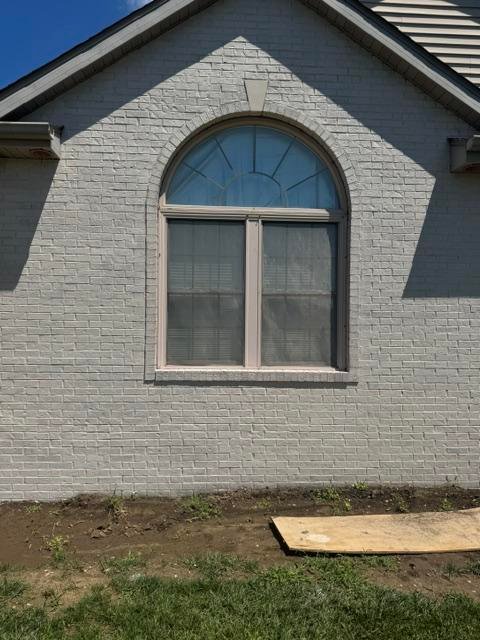
So naturally, I had chosen one of the darkest colors possible for light-colored vinyl sitting in some of the strongest sun our house receives.
Things were going well.
Fine. We’ll Paint Them White.
Once I realized how risky the dark paint could potentially be, I came up with a backup plan.
We could paint the window frames white and add black shutters.
The shutters would give me the dark contrast I wanted and help pull in the other Iron Ore elements without taking the same risk with the windows.
It made sense, but I wasn’t excited about it. The brick had become such an important part of the house, and I worried that adding black shutters would create an entirely different focal point. Instead of complementing the brick, they might compete with it.
I didn’t want to add something to the house simply because I couldn’t figure out how to make something else work. So I kept researching, asking people, and researching some more.
My Husband Was Ready to Paint Them
My husband, meanwhile, was considerably less concerned about all of this. He was ready to paint the windows.
Every new warning I found, every person I asked, every new reason I came up with for why we might permanently warp our perfectly functional windows—he kept telling me he wasn’t worried.
To his credit, though, he never pushed me to just do it.
He knew I wasn’t comfortable yet, so he let me research.
And research some more. And ask another person. And then probably ask one more person just to make sure.
I think he would have painted them weeks earlier.
I apparently needed several professional opinions and a contingency plan.
Then I Found PPG Permanizer
Somewhere in all of that research, I found PPG Permanizer exterior paint, and for a brief moment I thought I had solved everything.
Permanizer is an exterior paint designed with features including enhanced UV resistance and strong adhesion.
I was overjoyed.
For approximately five minutes.
Because the more I researched the actual vinyl, the less confident I became.
Finding a really good exterior paint didn’t automatically eliminate the concern about putting such a dark color over light vinyl.
So eventually, I went back to PPG.
And I happened to walk in at exactly the right time.
The Trip To PPG That Finally Made Me Do It
The salesman helping me was incredibly knowledgeable. Instead of just selling me a gallon of paint and wishing me luck, he actually called PPG technical support to talk through what I was trying to do.
And while I was there, a longtime customer who worked in construction happened to be in the store.
We started talking about the windows.
After hearing what I was worried about and looking at the type of window frames we had, he explained that because these particular pieces were hard, molded and already fixed into the shape they needed to hold, he personally wouldn’t hesitate to paint them.
He wasn’t worried about it.
Which was interesting, because I happened to know someone else who had been telling me essentially the same thing for quite some time. My husband was probably feeling pretty validated at this point.
The PPG salesman suggested that if I was still nervous, I could paint one window first. We were heading into seriously hot weather anyway, so we’d know pretty quickly how it handled the heat.
More importantly to me, he told me that if it did go wrong, I could come back and they would help me figure out how to undo it.
That was probably the final thing I needed to hear.
I had the salesman talking with PPG technical support, an experienced contractor telling me he wouldn’t hesitate, my husband telling me he wasn’t worried—and now I knew I wasn’t completely on my own if this turned into a mess.
I finally felt comfortable taking the risk.
And at that point, my husband was more than ready to take the reins and start painting. He had been confident about the windows from the beginning, but he’d also given me the time to ask all the questions I needed to ask before I got there too.
So we painted them.
We used PPG Permanizer exterior paint, color-matched to Sherwin-Williams Iron Ore (SW 7069).
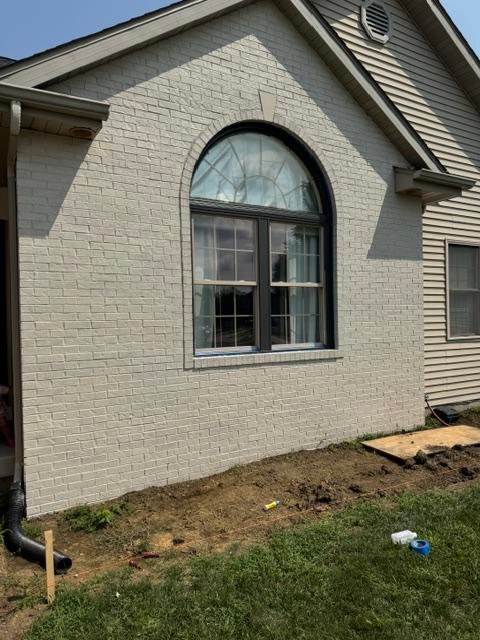
And they’ve been completely fine.
They’ve now been through the heat and direct sun that had me so worried in the first place, and we haven’t had any issues with warping or distortion.
Before You Go Paint Your Vinyl Windows Black…
This is where I need to be very clear.
Our experience does not mean every vinyl window can safely be painted a dark color.
The warnings are legitimate. Dark colors can increase the temperature of vinyl exposed to sunlight, and excessive heat can cause some vinyl products to warp or distort. The particular vinyl, window construction, climate, sun exposure and manufacturer requirements can all matter.
Painting them may also affect the manufacturer’s warranty.
So please don’t read this as:
“Keep the Couch painted theirs Iron Ore and nothing happened, so we’re good!”
That’s not what I’m saying.
I’m telling you what happened at our house.
We researched it, asked questions, talked with the paint store and got professional opinions about our particular windows.
Ultimately, we decided the risk was one we were comfortable taking.
And thankfully, ours have been just fine.
But We Did Actually Warp Something
For all the worrying I did about warping our vinyl window frames, those have been completely fine.
You know what did warp?
The screens.
Once the frames were painted, we decided to paint the screen frames too. On the windows surrounded by brick, we took the screens out to paint them.
That turned out to be the mistake.
When we went to put them back in, they had warped enough that they wouldn’t fit correctly anymore.
When we got to the other two windows against the beige siding, we weren’t making that mistake twice. We painted those screen frames while they were still in place, and they were completely fine.
But then I noticed something else. The actual screen material was beige, and against everything we had just updated, it suddenly looked old.
And because parts of the actual windows themselves are still beige too, there was now a lot more beige showing through my newly dark windows than I wanted.
So apparently painting the window frames wasn’t quite the end of the window project.
We decided to replace the old screens with black screening.
We decided to make the replacement screens ourselves, and even after replacing the first one, the difference was obvious.
The black screen blends much better with the darker frame and helps disguise some of the beige that’s still visible on the actual window.
Once we’ve finished making all of them, I’ll share that project separately—because making window screens from scratch turned into a project of its own.
After All That, I Still Haven’t Completely Made Up My Mind
From farther away, I love the Iron Ore window against the lighter brick.
It gives me exactly the contrast I was looking for.
Up close, though, I still don’t love seeing the beige portions of the actual window. The new black screen helps everything blend together and makes those pieces less noticeable, which is exactly what I was hoping it would do.
Then there’s the Iron Ore window against the beige siding.
That one still bothers me.
Same paint. Same house. Completely different effect.
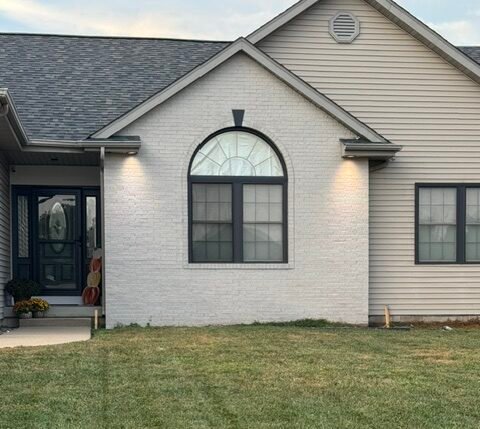
My first thought was to add black window boxes underneath both windows. They’d pull the dark color down, add flowers and greenery, and maybe make that window against the beige siding feel more intentional.
And honestly, I still think they could look beautiful.
But I’m not adding them yet.
Maybe It Isn’t the Window
The landscaping underneath those windows isn’t finished.
Once there are plants, height, texture and color there, the entire front of the house is going to look different.
I’ve spent enough time working on this exterior now to know that I don’t need to make another change just because something doesn’t look quite right in the middle of the process.
Maybe we’ll finish the landscaping and I’ll still want the window boxes. Maybe the black screens will be enough once they’re all finished. Maybe I’ll decide something else needs to change. Or maybe once everything around those windows is finished, I’ll realize they’re fine exactly as they are.
Sometimes the thing bothering you isn’t wrong. It’s just surrounded by unfinished things.
So we’re going to finish the screens, finish the landscaping, and then stand back and look at the whole house again.
As for those windows?
We’ll see.